From a Dancer's Diary #6: Following and Listening — The One Thing You Cannot Fake

A few months ago, a new student stood in front of me during our beginner course at Cyber Dance, arms stiff, eyes locked on her own feet. "I just need to know the steps," she said. "Then I'll relax." I told her the truth: the steps are the easy part. The hard part — the part that can't be memorized — is learning to listen with your body.
She looked at me like I'd spoken in another language. Two months later, on a random Thursday social, I watched her follow a lead she'd never danced with before, adjusting to his timing, his weight, his hesitation, without a single word passing between them. That's when it clicked for her. And, honestly, it's when it clicks for most people — not in the studio, but on the social floor, under real conditions, with a stranger.
The Follow Cannot Be Faked
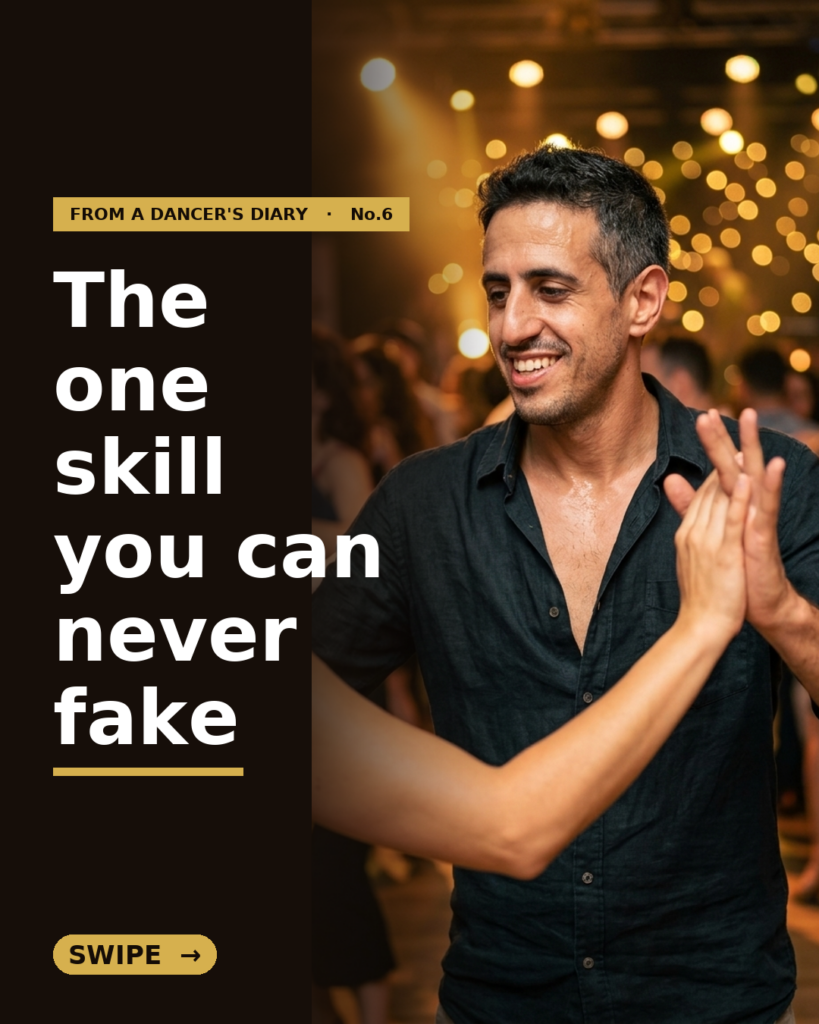
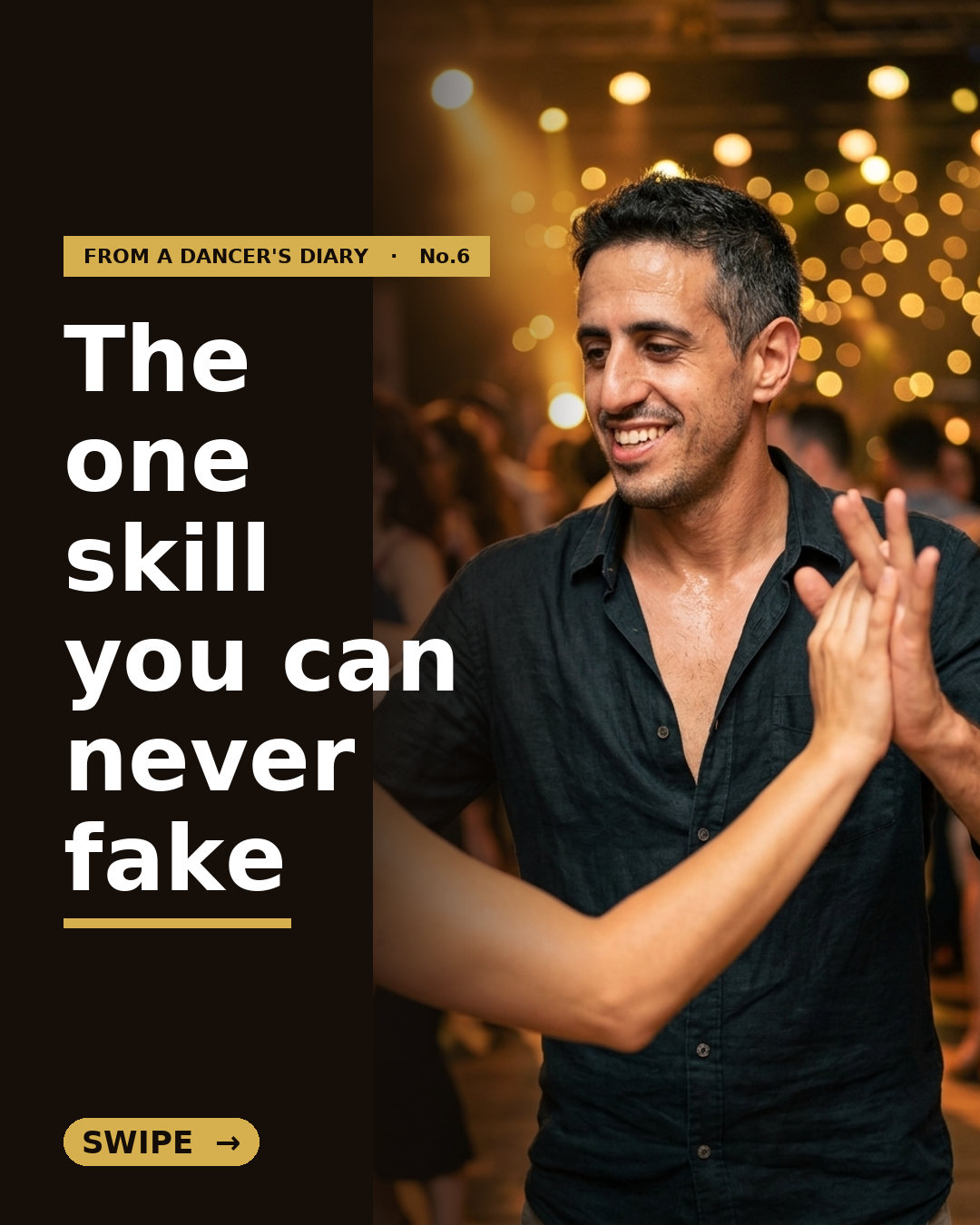
In Latin partner dance, especially in sensual Bachata, there's a persistent myth that leading is the hard job and following is the passive one. Anyone who has actually danced knows the opposite is often true. A lead can disguise a mediocre connection with confidence and clear signals. A follow has nowhere to hide. If she isn't truly listening — to the tension in his arm, the shift of his chest, the micro-pause before a turn — the dance falls apart in front of everyone. You can fake enthusiasm. You cannot fake responsiveness.
I've watched hundreds of beginners at our weekly socials in Rosh Pina, and the ones who progress fastest are never the ones with the best memory for patterns. They're the ones who stop performing "correctness" and start actually feeling what's being offered to them, moment by moment. That shift — from executing to listening — is the real beginning of dancing.
What Real Listening Looks Like
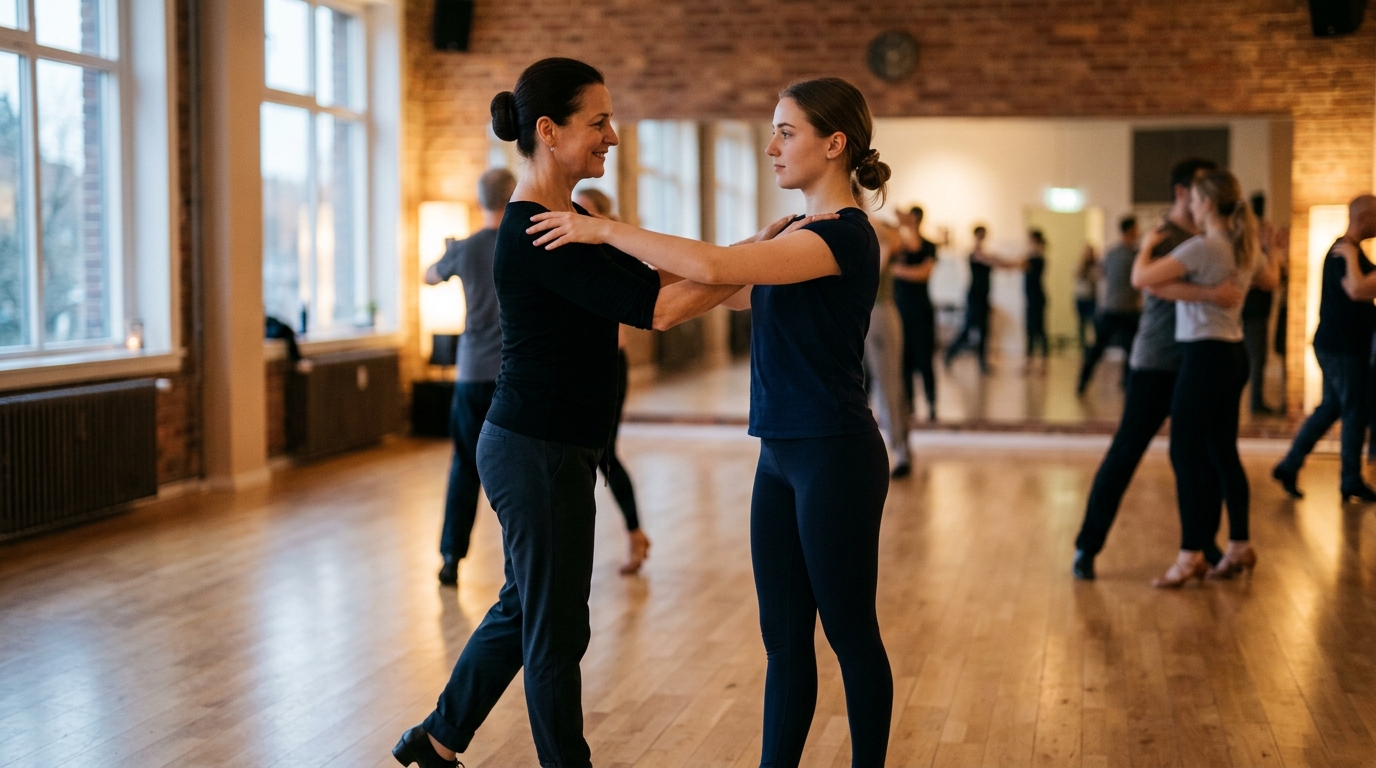
Real listening, on the floor, has almost nothing to do with the ears. It's felt through contact — a hand on a shoulder blade, a subtle pressure in the frame, the rhythm of someone's breath. A good follow doesn't wait for instructions; she reads intention a half-second before it fully arrives, and responds with just enough — not too much, not too little.
I see the exact same skill missing in boardrooms. In my cyber work — running risk assessments for banks, briefing executive committees on Zero Trust rollouts, teaching in the CAIO course — I meet plenty of smart, well-prepared people who are excellent at presenting and terrible at listening. They wait for their turn to speak rather than adjusting to what the room actually needs. I once sat through a session where a brilliant CISO delivered a flawless technical brief to a board — and lost them in four minutes, because he never once paused to read whether they understood, worried, or had already checked out. The content was perfect. The listening was zero.
The Discipline Behind the Skill
Following well is not submission — it's an active discipline, arguably harder than leading, because it requires constant, honest attention with almost no visible reward. At the UNO Festival, when I watch experienced followers dance with leads of wildly different levels — a nervous beginner one song, a confident performer the next — the good ones adjust their entire quality of movement to match what's actually being offered, not what they wish was being offered. That adjustment, made in real time, without ego, is the whole art.
It reminds me of something I learned in MAMRAM, building SOC capabilities years ago: the best analysts weren't the ones who reacted fastest to alerts. They were the ones who actually listened to what the data was telling them before jumping to conclusions — resisting the urge to impose a pattern they expected, and instead following what the system was actually doing. Same discipline, completely different floor.
Where This Shows Up Off the Dance Floor
Think about the last team meeting where someone announced a decision instead of testing it. Or the last family conversation where you were composing your reply while the other person was still talking. Genuine listening — the kind that changes your next move based on what you just received — is rare precisely because it's uncomfortable. It requires you to let go of your plan.
I tell my students something I genuinely believe: leading is an invitation, never a command. But an invitation only means something if someone is truly listening for it. A follow who isn't present will miss even the clearest lead. A team member who isn't present will miss even the clearest instruction. Presence is the entry fee for connection — in dance, in negotiations, in a NIST-based risk workshop, in a marriage.

Three Things I've Learned About Listening That Cannot Be Faked
- Stop rehearsing your response while the other person is still moving. On the floor, a follow who's already planning her next styling misses the lead entirely. In conversation, the same habit costs you the actual message.
- Contact tells the truth faster than words. A tense frame, a stiff handshake, a distracted glance — these arrive before any sentence does. Learn to read them, and you'll rarely be surprised later.
- Adjust to what's actually offered, not what you expected. Great followers dance the partner in front of them, not the partner they imagined. Great leaders in any organization manage the team they have, not the one on paper.
- Presence is a skill, not a personality trait. It can be trained — through repetition, through practice, through choosing, again and again, to actually be where you are.
Back to That Thursday Night
That same student, a few weeks later, told me she'd started listening differently in her own job — actually pausing before responding in meetings, actually noticing when a colleague's tone shifted mid-sentence. She hadn't set out to learn that on a dance floor. But that's usually how it happens: the body learns something the mind later recognizes.
The steps, in the end, were never the point. The listening was.
If you'd like to feel the difference between performing and actually listening, come try a class with us. At Cyber Dance in Rosh Pina, we teach Latin partner dance and Bachata for real beginners, run weekly socials where all of this becomes real, and welcome newcomers into the UNO Festival community across northern Israel. Reach us on Instagram @cyber.dance.il, call +972-50-2020086, or join here: https://edu.cyber-school.co.il/dance/.
Want to dance? Cyber Dance — a Latin dance school in Rosh Pina, Israel. Workshops & courses for every level · +972-50-2020086 · join here · IG @cyber.dance.il.