From a Dancer's Diary #5 — Lead from Your Center, Not Your Arms

There's a moment in almost every beginners' course where I see it happen. A student — usually someone sharp, decisive, used to getting things done — grabs his partner's hand and pulls. Not aggressively. Just… efficiently. Like he's steering a shopping cart. And she stumbles, half a beat behind, confused about where she's supposed to go.
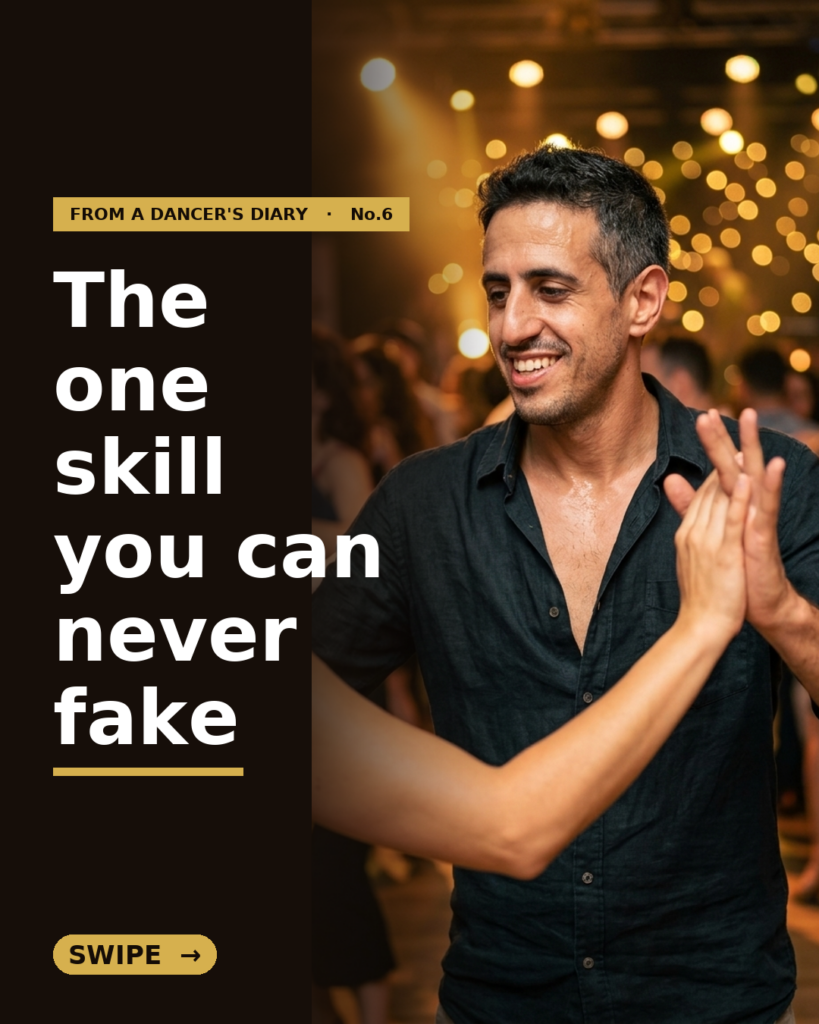
I stop the music. "You didn't lead her," I say. "You moved her."
He looks at me, genuinely puzzled. "Isn't that the same thing?"
It's the question that opens almost every course I teach, and it's the one I want to unpack here, because I've watched it play out far beyond the dance floor — in boardrooms, in project rooms, in every place where someone mistakes force for influence.
The Arm Is a Shortcut. The Center Is the Truth.
In bachata, the temptation to lead from the arms is enormous, especially early on. The arm is close, it's visible, it's easy to control. Pull the arm, and the follower's hand moves — problem solved, or so it seems. But the arm only ever tells half the story. Her body, her weight, her timing — none of that travels through a yanked wrist. It travels through connection: through your chest, your ribcage, your center, transmitted through frame and touch into her frame, arriving as information, not instruction.
A lead from the center says: here's where we're going. A pull from the arm says: get there, now, my way. The follower's body knows the difference instantly, even if her mind hasn't named it yet. She'll either trust the invitation and move with ease, or she'll brace against the force — and bracing is the opposite of dancing. It's defense.
I once partnered a new student, Noa, for a demo during a beginners' workshop. She'd never danced before that evening. I led everything from my chest and torso — no arm pressure at all, just clear, grounded intention. Within twenty minutes she was doing basic turns cleanly, because she never had anything to resist. There was nothing to fight. She just had to listen to a whisper, not survive a shove.
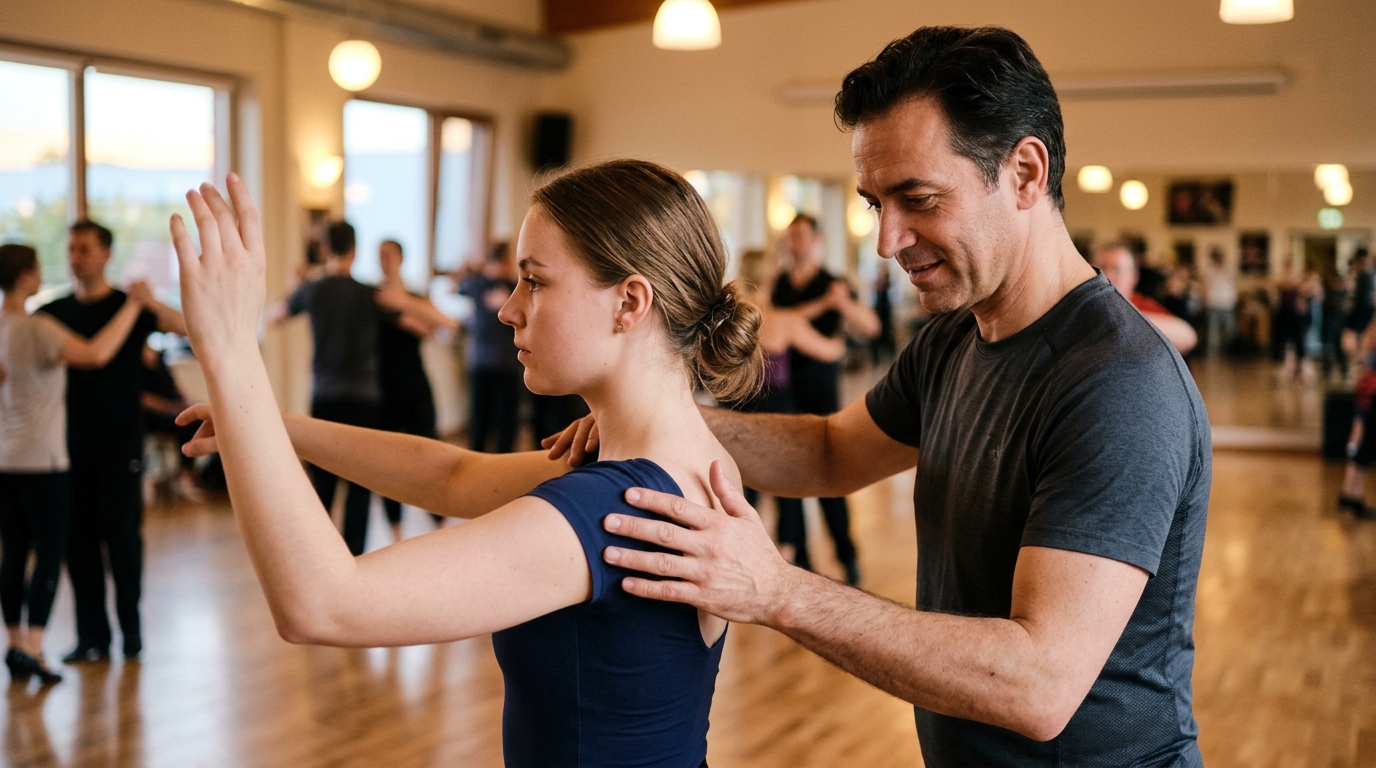
What "Center" Actually Means — On and Off the Floor
Leading from center isn't a metaphor I invented for dance class. It's physical: your core, your posture, your grounded weight. When your center is stable, your signals are clean. When you're off-balance — leaning, rushing, anxious — your arms compensate, and compensation always looks like grabbing.
I see the exact same pattern in cyber-risk conversations with executives. Years ago, working on an enterprise risk assessment for a bank, I sat across from a CISO who was frustrated that the board wasn't moving fast enough on a Zero Trust rollout. His instinct was to escalate — louder emails, tighter deadlines, more pressure on already stretched teams. It's the organizational equivalent of pulling the arm. It might produce short-term motion, but it produces resistance, not alignment.
We reframed the pitch instead: fewer mandates, more center. We grounded the ask in business impact — quantified exposure, realistic timelines tied to NIST and ISO milestones the board already understood, a narrative about enabling the business rather than restricting it. No pulling. Just a clear, grounded signal of direction. The board moved, and moved willingly, within one quarter. Influence that lasts is never extracted. It's offered, and it's felt through the center of whoever's making the case, long before it's heard in their words.
Following Is Not Passive — It's a Skill
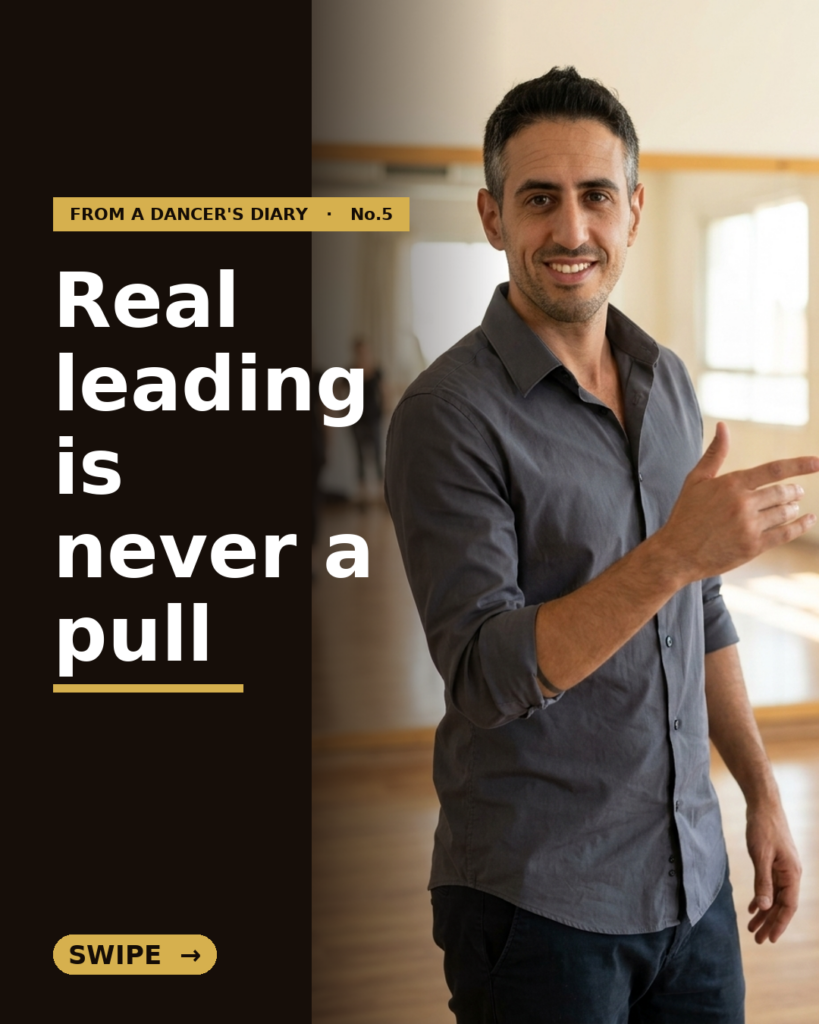
Something I insist on in every course: leading (הובלה) is an invitation, and following (מובלות) is an active, sophisticated art — not surrender. A great follower isn't a passive object being steered. She's reading pressure, tempo, intention, in real time, and choosing, moment to moment, to trust the signal and respond with her own musicality and expression.
That only works if the lead deserves the trust. If I'm pulling from the arm, I'm not inviting her skill — I'm bypassing it, treating her like a passenger instead of a partner. The best dances I've had — with Julia, on stage, or with a total beginner at a Thursday social — happen when the lead is quiet and the following is alive. Two active intelligences, one shared direction.
The same is true of teams. The manager who "leads from the arm" — micromanaging, over-specifying, pulling on every task — doesn't get a team. He gets a group of people executing instructions, minus their judgment, minus their best thinking. The leader who grounds himself, states direction clearly, and then trusts his people to interpret and move — that's the one who builds a team capable of improvising when the plan breaks, which it always eventually does.

Three Things I Ask My Students to Feel
- Ground before you gesture. Before initiating any move, settle your own weight and breath. A lead sent from an unstable base always turns into a pull.
- Signal, don't summon. Offer a clear intention and a moment for it to be received — in dance, in a meeting, in a difficult conversation. Force compresses that moment; trust needs it.
- Read the response, don't demand it. If your partner (or colleague, or team) hesitates, that's information, not disobedience. Adjust your center before you tighten your grip.
- Earn the follow. Influence isn't a right you hold by title or by strength — it's a trust your partner extends, dance after dance, decision after decision.
Back to Noa, and to the Board
Noa is a regular at our weekly socials now. Every so often I watch her dance with a new lead who's still pulling from the arm, and I see her body brace, politely, the way beginners do before they know they're allowed to say no. I'll step in, not to correct him publicly, but to remind the room, gently: the arm is a shortcut, and shortcuts always cost you the thing you actually wanted — trust, ease, a partner who wants to come back.
Real influence, on any floor, is never force. It's a center clear enough, and calm enough, that someone else chooses to move with you.
If you want to feel the difference in your own body — not just understand it as an idea — come try a class. We teach bachata and Latin partner dance at Cyber Dance, at the Rosh Pina community centre, with weekly socials where beginners and experienced dancers share the same floor. Message us on Instagram @cyber.dance.il, call +972-50-2020086, or join here: https://edu.cyber-school.co.il/dance/. Come find your center. The leading gets easier from there.
Want to dance? Cyber Dance — a Latin dance school in Rosh Pina, Israel. Workshops & courses for every level · +972-50-2020086 · join here · IG @cyber.dance.il.