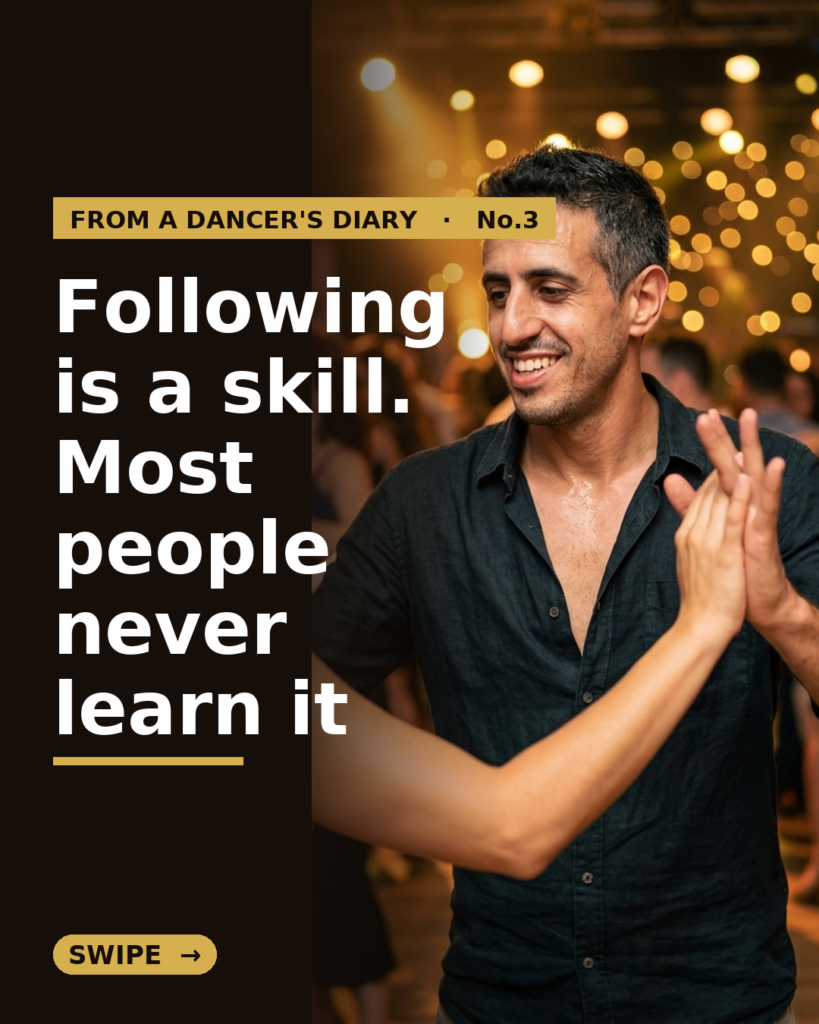
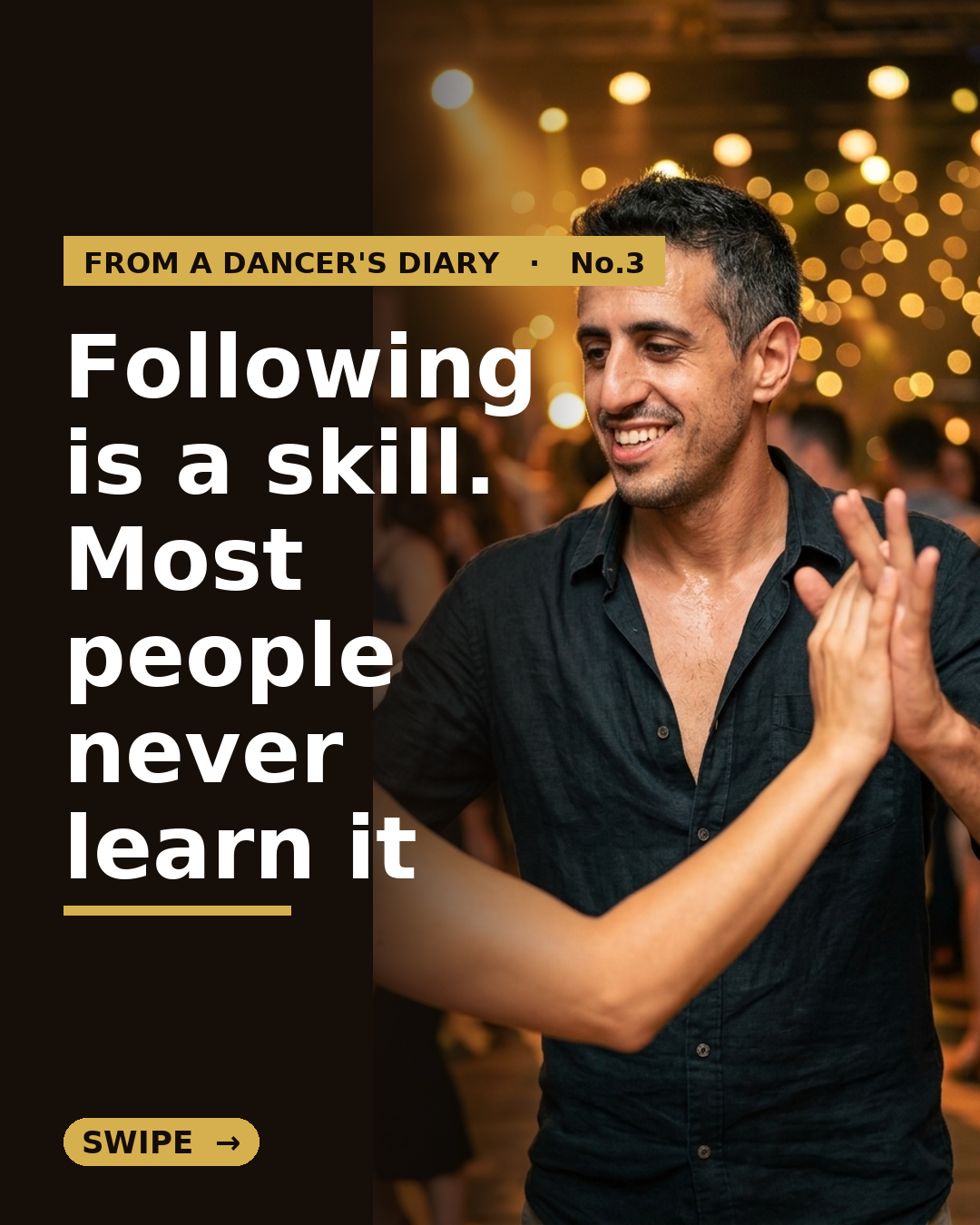
From a Dancer's Diary #3 — The Follow Is Not Passive: Why the Hardest Skill on the Floor Is Trust in Motion

There's a moment in almost every beginner class at Cyber Dance when I ask the follows to close their eyes. Not because it's romantic — because it forces them to stop watching my feet and start listening to my body. And almost every time, someone laughs nervously and says, "But how will I know what to do?" That question, right there, is the whole lesson.
The Myth of the Passenger
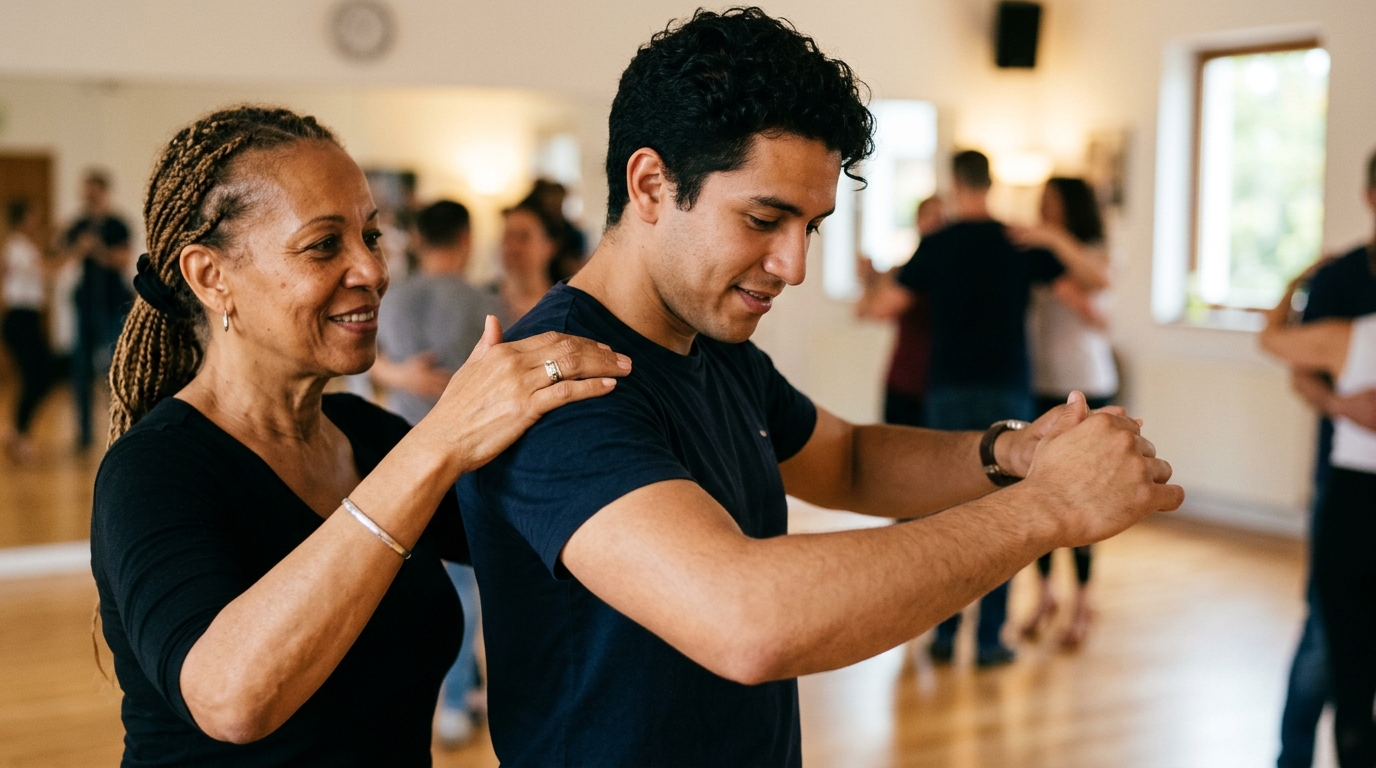
People who've never danced partner dance assume the follow is along for the ride. The leader decides, the follow obeys. I understand why — visually, the leader initiates the movement. But anyone who has actually danced knows the truth: a follow who is truly passive is a nightmare to dance with. She's dead weight. He's a sandbag. There's no conversation, only instruction, and instruction alone makes for a stiff, joyless dance.
The best follows I've danced with — including my partner Julia, whom I've performed with across stages in Israel and abroad — are doing enormous work that's invisible to the audience. They're reading tension in a fingertip. They're anticipating a turn a half-second before it's led, not because they're guessing, but because they've trained their body to receive information faster than words could carry it. That's not obedience. That's mastery.
What Active Following Actually Looks Like
In a typical sensual bachata combination, a lead might initiate a body roll with nothing more than a slight shift of weight through connected hands. If the follow is passive, nothing happens — she waits for something more explicit, the moment stalls, and the audience (or the social dance partner) feels the hiccup. If the follow is active, she catches that whisper of weight change and completes the movement with her own musicality, her own interpretation, her own timing within the frame she's been given.
I tell my students: following is not "doing what you're told." It's "answering what you're asked." A good follow negotiates in real time. She might interpret a lead's suggestion with more flair than he expected, and a good leader adjusts to that — the dance becomes a dialogue, not a script. I've watched absolute beginners transform in six weeks once they understand this: the moment they stop waiting to be moved and start actively meeting the lead halfway, their dancing looks a decade more experienced.
The Boardroom Parallel
I spend my weekdays in rooms that look nothing like a dance studio — assessing enterprise risk for banks, building Zero Trust architectures, running BDO's Security Academy, lecturing CISSP candidates. But I see the same misunderstanding about "following" play out constantly in organizations.
Too many people treat being a team member, a junior analyst, a new hire, as passive compliance: wait for instructions, execute exactly, don't improvise. I've seen it in SOC teams during live incidents — an analyst who only escalates what the runbook says to escalate, and misses the anomaly sitting right next to it because it wasn't explicitly assigned to them. Compare that to the analyst who takes the lead's direction — "check the lateral movement indicators" — and actively extends it: cross-references three additional log sources because something felt off. That's active following. It's the difference between an incident contained in twenty minutes and one that drags for six hours.
The best CISOs I've worked alongside, and the best junior consultants I've mentored at BDO, aren't the ones who follow orders best. They're the ones who follow intelligently — absorbing direction, then bringing their own judgment to complete it in a way the leader didn't have to spell out.
Why This Skill Is Actually Harder Than Leading
I lead in bachata. I also follow, sometimes, in workshops when I want to understand the connection from the other side. And I'll say honestly: following well is harder. Leading requires clarity of intention. Following requires simultaneous surrender and sharpness — you give up control of direction while keeping full command of your own body, your own timing, your own interpretation. You're not resisting the lead, and you're not going limp either. You're holding a taut, intelligent tension the whole time.
At UNO Festival, the community event I built to unite the Latin dance scene across northern Israel, I watch this play out on the social floor every year. The dancers who get asked to dance again and again aren't the flashiest leaders. They're the follows who make every partner feel like the dance is easy — because they're doing quiet, constant, skilled work to make the connection alive.

The Takeaways
- Following is interpretation, not imitation. Whether on the floor or in a team, receiving direction well means adding your own informed judgment, not just executing literally.
- Listen with your whole body, not just your ears. The best signals — in dance and in a crisis room — are often subtle. Train yourself to notice the small shift before it becomes an explicit instruction.
- Tension is not resistance. Active following means staying present and engaged, never limp, never rigid — the same posture that makes a good second-in-command indispensable.
- Judge people by how they follow, not only how they lead. In hiring, in mentoring, in partnering on the dance floor — active following is the harder, rarer skill, and it's the one worth watching for.
Back to the Studio
That student who closed her eyes and asked "how will I know what to do?" — a few months later, she was one of the most sought-after follows at our weekly social. She'd learned that not-knowing exactly, and trusting her own trained instinct to fill the gap, was the whole point. The dance floor teaches this before anywhere else can: the strongest people in any room are rarely the loudest instructors. They're the ones who know how to receive a signal, and do something intelligent with it.
If you want to feel this shift in your own body — not just understand it as an idea — come find us on a Tuesday evening in Rosh Pina. Cyber Dance runs weekly bachata classes and socials at the Rosh Pina community centre, for total beginners and returning dancers alike. Message us on Instagram @cyber.dance.il, call +972-50-2020086, or join through https://edu.cyber-school.co.il/dance/ — come learn what it really means to follow.
Want to dance? Cyber Dance — a Latin dance school in Rosh Pina, Israel. Workshops & courses for every level · +972-50-2020086 · join here · IG @cyber.dance.il.